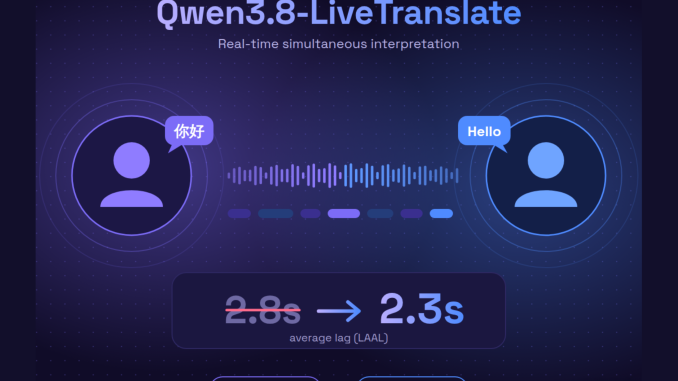

Qwen has released Qwen3.8-LiveTranslate, its next-generation real-time simultaneous interpretation model. It listens to live speech, with optional video frames, and returns translated text and speech while the speaker is still talking. The core change is a new Interleave architecture. Qwen reports gains in faithfulness, fluency, and conciseness, with average lagging (LAAL) dropping from 2.8 seconds to 2.3 seconds. The release also adds real-time speaker diarization, synchronized bilingual display, and long-context disambiguation.
Deployable? Yes, as a hosted API. It is live on Alibaba Cloud Model Studio and QwenCloud as qwen3.8-livetranslate-flash-realtime over WebSocket.
What Changed Under the Hood
Simultaneous interpretation is a tradeoff. Waiting longer gives the model more context. Speaking sooner cuts delay for the listener. Qwen3.8-LiveTranslate rebuilds this loop with an Interleave architecture.
The latency metric here is LAAL, or Length-Adaptive Average Lagging. It measures how far the translation trails the source speech on average. It also avoids rewarding systems that over-generate output. A drop from 2.8 seconds to 2.3 seconds is roughly an 18% cut in average lag.
QwenCloud team describes the model as the real-time version of Qwen3.8-LiveTranslate-Flash. It builds on the Qwen-Omni stack, large-scale multimodal data, cross-language and cross-modal alignment, and visual enhancement. The Flash model also supports offline audio and video translation.
Three New Capabilities
- Real-time speaker diarization: The model distinguishes speakers in multi-party speech. It also preserves each speaker’s voice through more stable voice cloning. The API exposes cloning modes, including an always mode that re-clones before each response for multi-speaker sessions.
- Synchronized bilingual display: Source text and translation appear on screen together. In the API, source transcription streams as its own events next to the translation stream.
- Long-context disambiguation: The model uses conversation history to resolve names and terminology. A name introduced early in a meeting stays consistent later in the translation.
Try the explainer below. It walks through the interleaved stream, speaker tagging, context disambiguation, language coverage, and session cost.