VP’s friend quizzed on P205K dinner
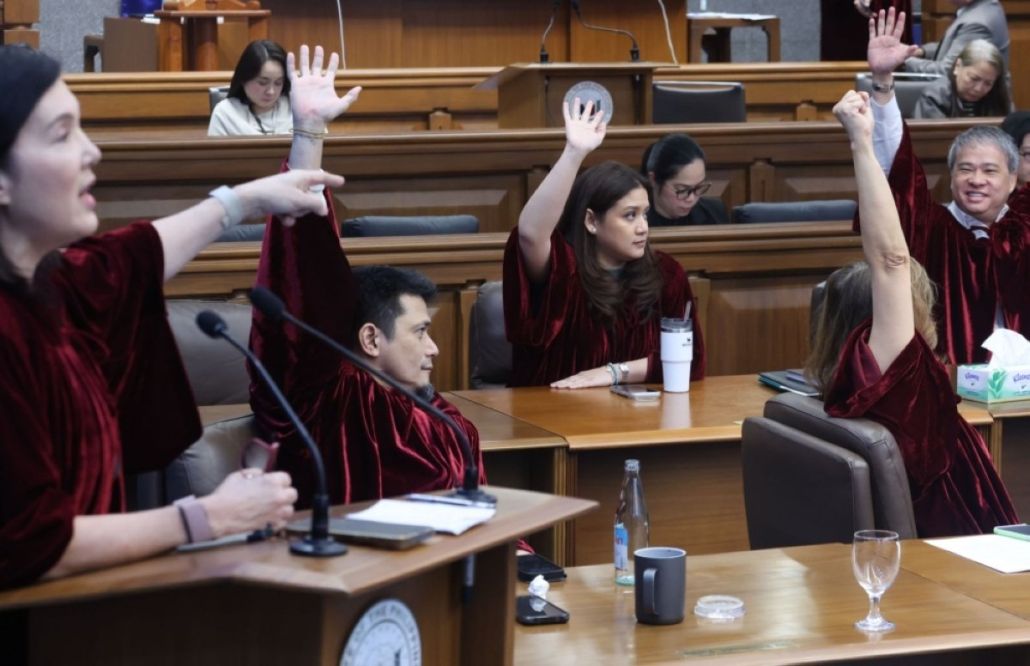
Photo: The Manila Times · Original story
A P205,000 bill for a Tokyo dinner, and hundreds of thousands of pesos spent on Nike shoes in Malaysia figured prominently in the 43rd day of Vice President Sara Duterte’s impeachment trial on Thursday, with prosecutors questioning whether these were consistent with the constitutional requirement for public officials and their families to live simply.House private prosecutor Amando Virgil Ligutan raised questions about a P205,007.29 dinner bill incurred by a group of 11 people at Inakaya Ginza in Tokyo, Japan, on May 19, 2023. The bill was charged to the vice president’s husband, Manases Carpio’s credit card.Questioning defense witness Anel Martin Antero, Ligutan argued that the expense was relevant to the allegation of unexplained wealth and whether Duterte and her husband maintained a lifestyle consistent with the standards expected of public officials.“The issue is whether a P200,000 meal is ostentatious and whether the vice president and her spouse are living a modest life. This is central to the allegation of unexplained wealth. The law provides that a public official and their family must live simply,” Ligutan said.He also asked whether ordinary Filipinos could afford to spend such an amount on a single meal.Antero testified that the dinner was attended by 11 friends, including Carpio, during their vacation in Japan. The group ordered tempura and seafood, but he admitted being surprised by the final bill.“I was personally surprised because we did not expect the bill to be that expensive,” Antero told the impeachment court.Ligutan also questioned the lack of supporting documents showing that all 11 attendees had participated in the dinner and subsequently paid their respective shares.Defense counsel Lindon Bacquel objected, arguing that the questions went beyond the scope of Antero’s direct testimony, which focused on the circumstances surrounding the credit card transaction. He also maintained that neither Antero nor Carpio was on trial.Antero acknowledged being a longtime friend of Duterte and Carpio, and confirmed that he was part of Carpio’s law firm, where he received compensation for his professional services.Another transaction involving Carpio also drew scrutiny during the proceedings, with defense witness Chadrin Parian testifying that the lawyer paid P256,882.50 for more than 20 pairs of Nike shoes during a trip to Kuala Lumpur, Malaysia, in June 2025.Parian, a Las Piñas resident, said Carpio shouldered the purchases for members of the Elite Philippines youth basketball team and some of their parents following the team’s victory in a tournament.During direct examination by defense counsel Justin Gular, Parian explained that he and Carpio traveled to Malaysia for their children’s basketball tournament. He described Carpio as a co-parent and manager of the team.Parian said the group toured Kuala Lumpur after winning the competition, and the children visited a Nike store at Pavilion Kuala Lumpur, where they selected shoes that Carpio paid for using his credit card.The defense presented photographs showing Carpio beside boxes of shoes and members of the basketball team holding Nike shopping boxes.Prosecution lawyer Reynaldo Robles stipulated that Carpio and the basketball team had traveled to Malaysia.Asked whether the purchase was consistent with the constitutional requirement for public officials and their families to observe a simple lifestyle, Parian said he could not speak for Carpio or explain his reasons for paying for the purchases.“Perhaps he was pleased with how things turned out — the kids won the tournament. The kids won ... They took turns covering the kids’ expenses,” Parian said.He also insisted that he was telling the truth and would not lie to protect Carpio.Senator-Judge Pia Cayetano criticized the prosecution’s questioning of Parian, particularly its references to constitutional provisions that the witness might not have been familiar with.“I will not hide my disdain. I will not. I cannot. I don’t even know where to begin,” Cayetano said following Robles’ recross-examination.She questioned whether the prosecution was suggesting that public officials and their relatives should be faulted for providing financial assistance to student-athletes.Cayetano also asked her fellow senators whether they had helped athletes by purchasing equipment or other necessities.“Have any of my colleagues here ever bought equipment or other necessities for athletes?” she asked.She cited Senators Joel Villanueva and Juan Miguel Zubiri as examples of lawmakers who had supported athletes and sports teams.The prosecution clarified that it was not questioning the act of helping young athletes but whether spending such a substantial amount was appropriate for a public official’s family.After Parian was quizzed about the vice president’s lifestyle, Duterte supporter Senator-Judge Robinhood Padilla challenged House prosecutors panel to examine their own ranks, asking whether members of the House of Representatives own luxury vehicles worth P16 million to P22 million.Addressing prosecution counsel Reynaldo Robles, Padilla asked if he was aware of congressmen who owned vehicles valued between P16 million and P22 million. When Robles replied that he did not know, the senator-judge delivered a pointed Filipino proverb aimed at House prosecutors.“We have a saying: ’Let us look at our own companions first before we bark,” Padilla said in Filipino.Meanwhile, Senate Presiding Officer Francis Escudero urged senator-judges and lawyers to exercise restraint in questioning witnesses, warning against conduct that could intimidate them rather than encourage truthful testimony.“While we may rigorously examine witnesses and test the credibility of their testimonies, we must refrain from resorting to a manner of questioning or to making declarations that elicit fear rather than candor,” Escudero said.Speaking during the 43rd day of the trial, Escudero reminded both prosecution and defense that witnesses were entitled to protection under Section 3, Rule 132 of the Rules on Evidence, which applies suppletorily to the impeachment proceedings.He said witnesses were required to answer questions even if their responses could establish a claim against them, but they were also entitled to protection from irrelevant, improper or insulting questions and harsh treatment.“The chair wishes to emphasize that an answer which may be unsatisfactory is not inherently contemptible,” he said, citing Supreme Court rulings that courts should exercise their contempt powers with the “highest restraint.”Escudero also reminded his fellow senator-judges that they were sitting as judges in a trial and were expected to evaluate evidence impartially and patiently.“We are sitting as senator-judges in a trial. Our rules behoove us to receive and evaluate the evidence with impartiality and, due to the often lengthy examination by both parties, with utmost patience as well,” he said.Acknowledging that repeated answers such as “I do not know” or “I do not recall” could be frustrating during lengthy proceedings, Escudero said senator-judges must nevertheless remain mindful of their responsibility.“What we can control, however, is how we appreciate and weigh the testimonies and statements delivered before this Court,” he said.He recalled his earlier remark that his patience was wearing thin but stressed that the impeachment court owed it to the parties, witnesses and the institution to uphold fairness and respect.In a separate development during Wednesday’s proceedings, Senator-Judge Panfilo Lacson questioned defense witness Suzette Balucanag-Punay, counsel for GenCorp Industries Inc., on whether a notarized admission against interest carried greater evidentiary weight than official public documents, including records filed with the Securities and Exchange Commission (SEC).“From what I know, admission against interest has greater probative or admissibility weight,” Lacson said after Balucanag-Punay maintained that SEC records carried greater weight.He referred Balucanag-Punay to Section 27, Rule 130 of the Rules of Court, which provides that the act, declaration or omission of a party concerning a relevant fact may be admitted in evidence against that party.Lacson also cited a case involving a person who was imprisoned after making an admission against interest on television.“I know someone who made an admission against interest on television and is now in jail. In this case, we have a notarized SALN,” he said.Lorna Kapunan, one of the private lawyers assisting the House prosecution panel, agreed with Lacson, arguing that an admission against interest ranked highly in the hierarchy of evidence.“May I call the court’s attention, and rightly pointed out by Senator Ping, admission in the hierarchy of evidence is the highest. It is the highest in terms of hierarchy of evidence,” she said.Lacson also found an opportunity for humor amid the lengthy proceedings, announcing that he was compiling an “impeachtionary” glossary of terms used during the impeachment trial.In a post on his X account on Thursday, he listed three entries: “loose investment,” “return of capital” and “wiwi break.”The first two terms surfaced during Day 42 of the trial when Balucanag-Punay testified that Duterte received P2.14 million from GenCorp between 2022 and 2025 as a return of capital from what she described as a “loose investment” in a Jollibee branch in Davao City.Balucanag-Punay said Duterte made the investment in 2007 and that both the branch and the investment were transferred as different companies took over its operations.She added that Duterte had no shareholdings or position in GenCorp from 2022 to 2025.When Escudero asked her to explain the term “loose investment,” Balucanag-Punay said she had coined it herself.The third entry, “wiwi break,” came from Kapunan, who used the expression when requesting permission to go to the bathroom during her cross-examination of Balucanag-Punay.During the same proceedings, Lacson also questioned why anyone would declare an asset in a statement of assets, liabilities and net worth (SALN) if that person had never owned it.“Would you have declared an asset in your SALN that you’ve never owned or had in the first place and in fact at any point in your life? ... Because if you did, it defies logic and even common sense,” he asked.Punay agreed that declaring an asset one had never owned would be illogical and contrary to common sense.The proceedings formed part of the Senate’s examination of testimony and financial transactions raised in connection with the impeachment allegations against Duterte.Forensic financial analyst Alexander Cabrera has estimated the alleged unexplained wealth at least P817.87 million.
Read the full story at The Manila Times.