Trump: US, PH forge ‘very big trade deal’
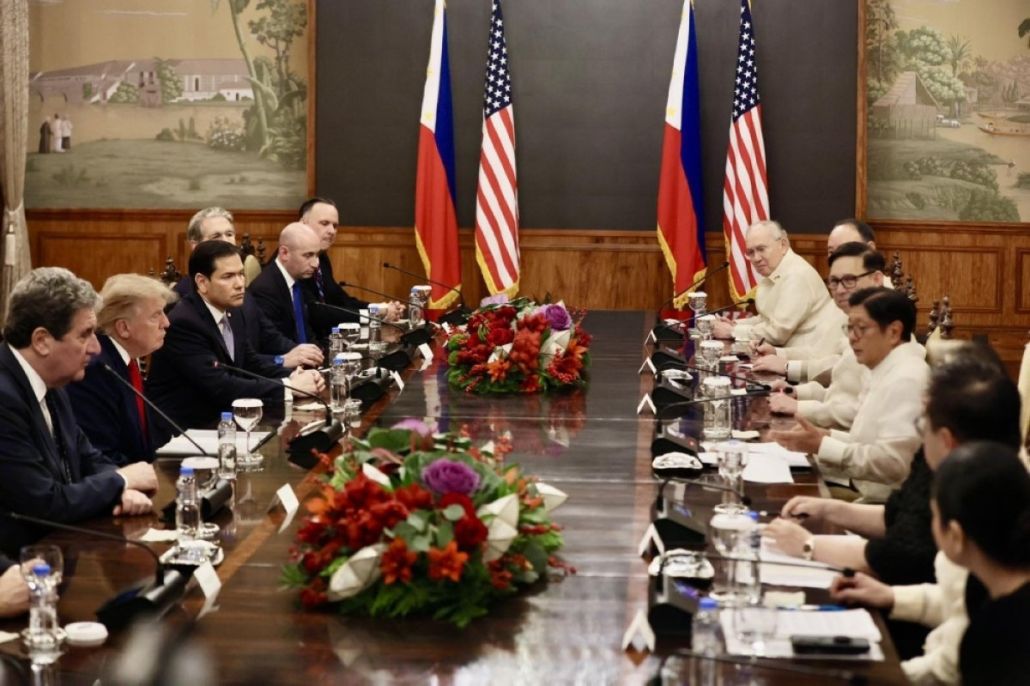
Photo: The Manila Times · Original story
UNITED States President Donald Trump on Wednesday said he and President Ferdinand Marcos Jr. have consummated a “very big trade deal.” Trump made the announcement during the state luncheon hosted by Marcos for his American counterpart and his delegation that included State Secretary Marco Rubio.“We’ve just consummated a very big trade deal — the biggest trade deal we’ve ever made, by far. It’s a great deal for both countries, and we’re very happy with it,” Trump said.“We didn’t know what was going to take place, but it took place very quickly, and it’s a magnificent deal for both [countries],” Trump said. He did not elaborate.“So, today under the leadership of President Marcos and myself, I’m proud to say that we’re making the alliance between the United States and the Philippines, much stronger than it’s ever been before, especially with the consummation of this deal,” he added.Sought to clarify Trump’s remarks about the trade deal, Philippine Ambassador to Washington Jose Manuel Romualdez said, “The US offered for us to diversify our food supply and energy requirements.” Marcos said the partnership between the Philippines and the US extended “well beyond defense and security.”“We are building stronger ties in trade, in investment, in energy, in technology, resilient supply chains, education, many other areas that directly affect the lives and the aspirations of both our peoples,” the president said.Malacañang in a statement said the Philippines and the US have reached an understanding on key areas of economic cooperation, particularly in energy and food security.“Moving forward, trade representatives from both countries will work closely to translate these commitments into concrete initiatives that will strengthen bilateral trade, enhance supply security and deliver long-term economic benefits for both nations,” the Palace said.The president said the Philippines “deeply values the United States as a trusted friend, a steadfast partner and an enduring ally.” “We also value the personal engagement and commitment that you have brought to our relationship, ensuring that both our peoples are safer, stronger and more prosperous,” he said.“I’m confident that your visit will give fresh momentum to our partnership and open new opportunities for our two countries to work even more closely together for our peoples, for our region, for the peace and prosperity that we all seek,” Marcos told Trump.Stable allianceDuring their meeting on Wednesday in Malacañang, Trump said there have been previous Philippine administrations where the alliance with the US became unstable.He noted, however, that under Marcos’ administration, the two nations’ alliance has since improved.“We’ve been your ally, but not as close as it is now. And then you had some moments where that alliance wasn’t very good during a couple of administrations ago. It was not a very good alliance, but our alliance has never been better,” said Trump.The bilateral meeting comes as Manila and Washington marked 80 years of their diplomatic relations and the 75th anniversary of the 1951 Mutual Defense Treaty.Trump further noted that Washington has supported historic increases in foreign military financing for the Philippines and approved about $5 billion in arms sales, which forms part of the ongoing expansions in the US defense industrial base to accelerate deliveries for allies.He also pointed to the trilateral Luzon Economic Corridor — launched alongside Japan — which aims to draw $100 billion in investments into critical industries and economic security across the Philippines.As the US positions itself as a natural energy partner, Trump cited plans to export liquefied natural gas from a major new pipeline in Alaska to Pacific allies and expressed strong support for collaborating on the Philippines’ first modern civilian nuclear energy project.Marcos echoed this commitment, underscoring that the US remains the Philippines’ sole treaty ally and noting that both countries are exploring new frontiers of collaboration, particularly in technology and artificial intelligence.“The United States is our only trading ally, and our relationship has continued to grow and evolve over the many years,” he said.“Now we are also exploring new areas of cooperation, particularly in technology, where American leadership and innovation continue to lead the way. We also see tremendous opportunities to work more closely through American leadership and superintelligence,” he added.He expressed optimism that the two nations will work “more closely” in the future as they deepen their partnership.In an ambush interview, US Ambassador to the Philippines Lee Lipton said the draft framework for the Pax Silica initiative within the Luzon Economic Corridor will not be signed during Trump’s brief Manila visit.Marcos echoed Lipton’s statement, saying the signing will not take place during “this trip.” “We are not covering that on this trip,” he said.The US-led Pax Silica initiative aims to build a 4,000-acre semiconductor hub at the New Clark City in Capas, Tarlac.The announcement of the Philippines’ participation in the deal has brought massive protests opposing the project, after it was reported that Indigenous communities residing in the area where the project will be built might be displaced.Trump cheerleaderA critic of the initiative, ACT Teachers Party-list Rep. Antonio Tinio on Tuesday urged President Marcos to stop acting as Trump’s “cheerleader,” accusing him of allowing the Philippines to become subservient to Washington at the expense of national interests.Tinio made the criticism as Trump touted his commitment to Philippine sovereignty during his Manila visit for the 49th Asean Summit, questioning the US president’s assurances amid American military presence and influence over Manila’s foreign and defense policies.“How can a country be sovereign when it hosts nine and counting US military bases under EDCA (Enhanced Defense Cooperation Agreement), when American warships and troops traverse our territory at will, and when our foreign and defense policies are dictated from Washington?” Tinio said.Tinio said the US-Philippine military partnership could bring more military installations and exercises that heighten regional tensions, while trade arrangements favor American goods at the expense of Filipino farmers and local industries.He questioned Trump’s pledge to support US partners “100 percent,” pointing to Washington’s backing of wars abroad, and argued that the Philippines’ defense pact with the US risked entangling the country in conflicts that Filipinos have no stake in.Tinio called for an independent foreign policy anchored on national interest and peaceful relations with neighboring countries, warning against turning the Philippines into an American military outpost in the Indo-Pacific.Warm welcomeTrump, fresh off his Republican Party’s drubbing in midterm elections, was received by rows of troops and a brass band at the presidential palace as the Philippine segment of his trip neared an end.Since touching down on Tuesday, he’s met with the so-called Quad security alliance, hailed a coming Thailand trade deal and huddled with leaders from the 11-member Association of Southeast Asian Nations.The US leader also touted an expansion of defense cooperation with Manila and suggested US nuclear technology could help ease the country’s energy woes.Marcos in March declared a “national energy emergency” in the wake of the US-Israel attacks on Iran that led to the closure of the Strait of Hormuz and sent fuel prices soaring in the import-dependent archipelago.“For the Philippines to embrace American technology in its first modern nuclear project would underscore the strength of the important relationship. And we’re going to probably do something very big having to do with nuclear,” Trump said on Tuesday, without offering details.Numerous countries, including Japan, Russia, France and South Korea, have been involved in talks aimed at introducing nuclear power to the Philippines for the first time.Hayley Channer, of the Sydney-based United States Studies Center, called Trump’s decision to stop in Manila en route to Shenzhen “significant,” saying he had a “strong personal relationship” with Marcos.At a gala dinner on Tuesday evening, Trump praised Marcos’ parents as “great” despite their exile in disgrace after the toppling of Ferdinand Marcos Sr.’s dictatorship in 1986.“I knew your parents very well, and they were great,” he told a gala dinner of Asean leaders hosted by Marcos on Tuesday. “You have very good genetics, I can tell you that.” But the two treaty allies also share a raft of security concerns in the Pacific, from Manila’s ongoing clashes with China in the disputed South China Sea to the ever-present threat of war over the Philippines’ northern neighbor Taiwan.“President Trump sees huge strategic value in the US’ relationship with the Philippines, which has been on the front line of China’s territorial aggression in the South China Sea,” Channer said.A complex historyThe US has a long and complex history with the Philippines, a former colonial possession, with the presence of US troops in the Southeast Asian country still a sensitive issue.But under Marcos, access for US troops at Philippine bases has been broadly expanded, joint patrols in the South China Sea have increased, and thousands of troops from both countries work together in large-scale annual exercises.In April, more than 17,000 soldiers, airmen and sailors took part in the 19-day Balikatan, or ”Shoulder to Shoulder,” exercises.Marcos warned in November 2025 that given his country’s proximity to the island democracy, “a war over Taiwan will drag the Philippines, kicking and screaming, into the conflict.” WITH AFP
Read the full story at The Manila Times.